

As much as we would love every relationship we have with others to be a river of rainbows which we gently and happily drift down together, life just isn’t like that. Sometimes there are rainbows and sometimes there aren’t. Sometimes churning rapids shatter the peace and sometimes we drift further and further apart, realising too late that our river has split and we have each taken a different stream. Sometimes all we want to do is smack some sense into the other person with one of our oars…
The bottom line is that rainbows or not, we each bring a lifetime of experiences and a head-full of thoughts, beliefs, values and dreams to our relationships. And when we don’t explore and communicate what’s going on in our heads and then negotiate some common ground, the situation can become volatile. But there is no need for any piñata smacking to reveal the juicy thoughts inside our friend, family member, co-worker or partner’s head, just an agreement to be open and honest and to really listen to what the other person is saying instead of hearing what we choose to hear.
One of the biggest causes of tension in relationships is when we tolerate something the other person does that bothers us. We might quietly stew for a while or we might have a really low boiling point – but sooner or later, we either explode or implode. We might have a huge emotional outburst with angry words we can’t take back, or we might withdraw into ourselves because we feel rejected, unheard and unseen.
Consider a possibly hypothetical past situation where a couple – let’s call them Haroll and Melissca – had constant disagreements about scheduling. From Melissca’s perspective, Haroll was disorganised, haphazard and didn’t get enough done because he wasn’t planning everything to the minute. From Haroll’s perspective, Melissca was uptight, controlling and was stressing him out because she was constantly trying to plan his life for him. Melissca was an imploder and Haroll was an exploder, and there was a LOT of “ploding” of both varieties going on, because neither could see the other one’s perspective. Luckily the story had a happy ending. The couple loved each other enough to figure out that they could use their words to communicate why each one felt as they did. It turned out that Melissca’s anxiety made it very hard for her to cope with uncertainty and scheduling lifted a big part of that burden from her shoulders. And it turned out that Haroll was so exhausted from work and all his other responsibilities that he was desperate for some time to just relax and be spontaneous. The couple worked together to find common ground that met both their needs and they lived happily ever after… until the next time Haroll let the dogs in on a rainy day without drying their muddy paws…
Whether you want to enhance the rainbows and make them last, or just be able to drift down the relationship river amicably, you have to be willing to put in the effort to make things work.
So, practically speaking, how would this effort look? What can you do when something in a relationship is bugging you?
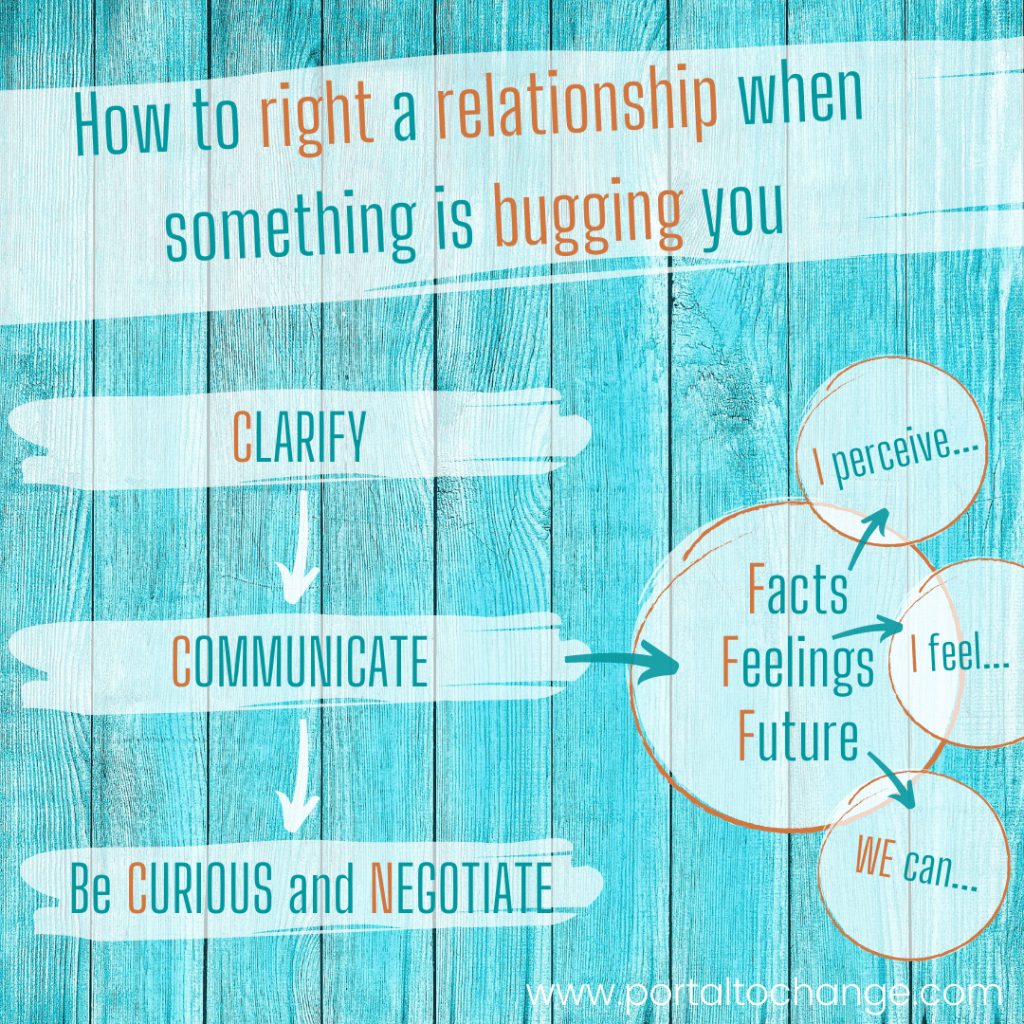
Step 1 – Clarify
Start out by digging deep and being honest with yourself about what’s really bothering you. You might begin by labelling what you’re feeling as annoyed, frustrated or angry, but take some time to figure out what lies beneath those feelings. You’ll usually come up with much more accurate labels, like rejected, ignored, stressed, misunderstood, disrespected etc.
Dig right down to the root of what you’re feeling and why you feel that way before moving on to the next step.
Step 2 – Communicate
Now that you’re got your thoughts and feelings figured out, you can move on to communicating them. You can do this in three parts:
Part 1 – Communicate the facts from your perspective
Tell the other person what’s bugging you in a simple, straightforward way using “I” language instead of “you” language. This starts things off in a way that doesn’t make the other person feel ambushed, cornered or defensive.
For example, you may want to avoid saying something like: “You only call me when you want something – tech-support, a babysitter, someone to agree with you about how terrible your day was… but you never bother to ask me how I am or what’s going on with me! Friends are supposed to be there for each other, but you wouldn’t know friendship if it pushed you over, sat on you and wrote “I’m the most selfish person on earth” on your forehead with a permanent marker!”
Something like this might be better: “I’d really like to talk to you about something that’s been bothering me. I feel like you haven’t been contacting me unless you need something and I feel like my life and my struggles aren’t important to you.”
Part 2 – Communicate your feelings
Next, tell the other person how what you perceive has been happening makes you feel. Again, keep the focus on using “I” language instead of “you” language.
For example, something along the lines of: “You make me so angry when you can’t leave your phone alone for even two minutes! Let me stick it to my forehead so that I can at least pretend that you haven’t forgotten how to look me in the eyes!” wouldn’t be advisable.
What may work better is something like: “I feel so lonely and rejected when we’re in the same room but you choose to look at your phone instead of spending time with me.”
Part 3 – Communicate your hopes for the future
Finally, tell the other person about any ideas you have that will enable you to work together towards a solution. Use “we” language instead of “you” language to suggest some alternatives to the way that things currently are.
For example, try not to say something like: “You had better stop leaving your stuff lying around the house because one day I’m going to trip over it, break my neck and die. And then you’ll either have to learn to cook or get used to life as a caveman because you know your father only knows how to cook braaivleis.”
Something like: “It would be wonderful if we could agree to pick up after ourselves so that the house stays clean and tidy without the task of cleaning up falling on only one person.”
Step 3 – Be curious and negotiate
Communication within relationships should always go both ways, so after you’ve had your say it’s time to listen to the other person’s perspective. Listen with curiosity and with the intention to understand rather than to reply, argue or defend.
If the other person becomes confrontational or defensive, remember that it will be very difficult for them to remain in that state if you stay calm, curious and open to their perspective. Find out how they feel about what you have said, if they have anything to add and whether one of the solutions you suggested would be acceptable to them? Do they have any other suggestions for solutions that will work for both of you?
Remember that the goal of the entire interaction should be to find common ground, understanding on both sides for the other side’s perspective and feelings, and the negotiation of a win-win way forward.
With enough hard work from both sides, we can have incredible relationships with others. Some of those relationships will be full of rainbows – made more beautiful by the storms we have faced together. And some of them will be mostly calm, disturbed only every now and then by an obstacle or two to keep things interesting.
Wishing you rainbows, calm waters and the wisdom to know when it’s time to wave goodbye and set sail in a different direction.

 Portal to Change